Arturo Herreros
Keywords:
Arturo Ciriaco Herreros Alvarenga, biography, Latin American architectureAbstract
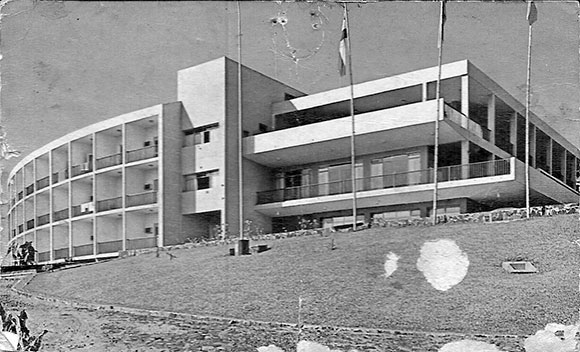
The aim of this text is to analyze the life and work of one of the pioneers of Paraguayan architecture of the second half of 20th century, Arturo Ciriaco Herreros Alvarenga. He received his architect diploma registered with the number “one”, as part of the first generation of architects graduated in Paraguay, from the first school of architecture of the country, founded in 1957. Herreros participated actively as a designer and constructor in numerous public and private works, and set the startline of a collective production of an architecture made in Paraguay. This article describes the constitution of the first school of architecture of the country, presents the professional trajectory of Herreros, and analyzes two of his most emblematic works. In this way, it seeks to contribute to the recognition of professionals still absent in Paraguayan and Latin American architecture historiography.
Downloads
References
Biagi, M. (2017). Constructing differently. Casabella, 874, pp. 102–103.
Blanc, J. (2018). Itaipu’s Forgotten History: The 1965 Brazil–Paraguay Border Crisis and the New Geopolitics of the Southern Cone. Journal of Latin American Studies, 50(2), pp. 383–409.
Cavalcanti, L. (2001). Quando o Brasil era moderno: Guia de arquitetura 1928-1960.Brasil: Editora Aeroplano.
Cavalcanti, L. y Caldeira, M. (2009). The Role of Modernists in the Establishment of Brazilian Cultural Heritage. Future Anterior, 6(2), pp. 14–31. Recuperado de: http://doi.org/10.1353/fta.0.0037
Centro de Estudiantes de Arquitectura (1952, Diciembre). Plan de Estudios de la Facultad de Arquitectura. Exposición de Motivos.
Comas, C. E. (1998). Modern Architecture, BrazilianCorollary. AA Files, 36 (summer), pp. 3–13.
Diarte, J. (2009). Reconstrucción del proyecto: Affonso Eduardo Reidy (1st ed.). San Lorenzo, Paraguay: Facultad de Arquitectura, Diseño y Arte.
Diarte, J. (2015). Confluencias arquitectónicas Paraguay-Brasil. En A. Orue (Ed.), Relaciones Bilaterales Paraguay-Brasil: Sociedad, Economía y Cultura. (pp. 95–132). Ciudad del Este, Paraguay: Editorial Escuela de Postgrado.
Ferraz, M., Puntoni, Á., Pirondi, C., Latorraca, G. y Artigas, R. (Orgs.) (1997). Vilanova Artigas. Série Arquitetos Brasileiros. São Paulo, Brasil: Fundação Vilanova Artigas, Instituto Lina Bo e P.M. Bardi.
Fleitas, B. (2006). La documentación como instrumento de preservación de edificios patrimoniales: Diagnóstico de manifestaciones patológicas y recomendaciones para el saneamiento del Hotel Guaraní. Asunción, Paraguay: Universidad Nacional de Asunción.
Gray, D. (2000). 2° premio Mies van der Rohe de arquitectura latinoamericana. Barcelona, España: Fundación Mies van der Rohe.
Hepner, A. y Macedo, S. S. (2016). Landscaping Brazil: The legacy of Roberto Burle Marx. Architectural Design, 86(3), pp. 118–125. Recuperado de: http://doi.org/10.1002/ad.2054
Informe de gestión SENAVITAT (2018). Rendición de cuentas. Gobierno Horacio Cartes. 2013-2018. Borrador actualizado a Mayo 2018. Recuperado de: https://www.muvh.gov.py/sitio/wp-content/uploads/2018/07/Informe-de-Gesti%C3%B3n-SENAVITAT-Borrador-Actualizado-a-Mayo-2018.pdf
Kostrencic, K. (2015). Descifrando la Arquitectura Experimental Latinoamericana: Un enfoque en los Detalles Constructivos realizados con los Materiales Tradicionales. Barcelona, España: Universidad Politécnica de Catalunya.
Morra, C. (2008). Hotel Guaraní: La Marca del Lugar. Correo Semanal de Última Hora. Recuperado de: https://www.ultimahora.com/tema-central-del-correo-semanal-la-marca-del-lugar-n112953.html
Piñón Pallares, H. (2010). Arquitectura de la ciudad moderna. Barcelona, España: Universitat Politécnica de Catalunya, PubliCEP.
Piñón Pallares, H. (2016). Arquitectura del proyecto. Recuperado de: https://helio-pinon.org/escritos_y_conferencias/det-arquitectura_del_proyecto_i71050
Read, J. (2005). Alternative Functions: Oscar Niemeyer and the Poetics of Modernity.Modernism/Modernity, 12(2), pp. 253–272. Recuperado de: http://doi.org/10.1353/mod.2005.0066
Rivero, I. (2013). Super Rural. In B. Hoidn (Ed.), Abu & font house Surubí house. (pp. 21–31). Austin, USA: The University of Texas at Austin.
Rodriguez, F. (2006).El fin de la arquitectura. Aportes de este lado del mundo.Summa+, 79, pp. 58–71.
Salama, A. M. y Wilkinson, N. (2007). Introduction: Legacies for the Future of Design Studio Pedagogy. In A. M. Salama & N. Wilkinson (Eds.), Design Studio Pedagogy: Horizons for the Future. (pp. 3–10). Gateshead, Inglaterra: The Urban International Press.
Yampey, M. (2007). Memoria de la fundación de la Facultad de Arquitectura. Revista Re-Creando, 3, pp. 10-13. Recuperado de: https://issuu.com/publicaciones-fada/docs/recreando_tres