Diagnóstico del comportamiento térmico de edificios en forma masiva mediante el uso de la termografía infrarroja
Palabras clave:
Termografía infrarroja, Diagnóstico térmico rápido, Edificios existentesResumen
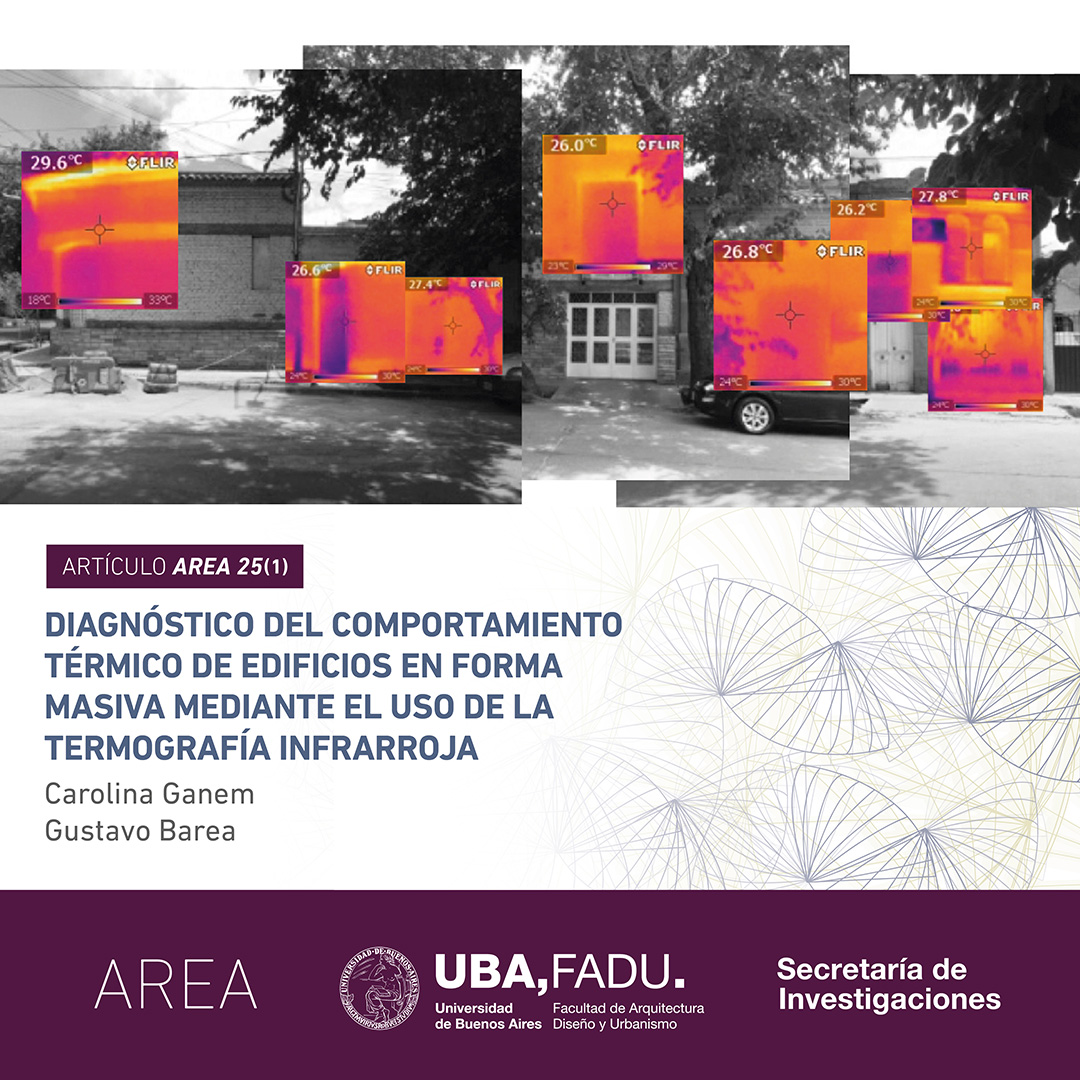
El objetivo de este trabajo es realizar el diagnóstico del comportamiento térmico de edificios mediante el uso de la termografía infrarroja y evaluar la utilidad de esta herramienta para una evaluación rápida y confiable. Se seleccionó un barrio representativo de la edificación existente en la ciudad de Mendoza, Argentina (32°40’ Lat. Sur, 68°51’ Long. Oeste, 750 m s. n. m.). Se trabajó con 48 perfiles urbanos, 12 en cada una de las cuatro orientaciones de la cuadrícula. Se siguió un protocolo específico: 1) Se procedió a la toma de imágenes termográficas en dos momentos del día, la tarde-noche y la mañana temprano, para evitar posibles errores debidos a la incidencia de radiación solar directa.
2) La emisividad se introdujo en la cámara de acuerdo con estudios de materiales locales. Al mismo tiempo, se realizaron mediciones continuas de la temperatura del aire en el interior y exterior con registradores de datos con el objetivo de examinar en detalle los resultados obtenidos mediante el estudio termográfico.
Descargas
Referencias
Alchapar, N. y Correa, E. (2015). Solar reflectance of opaque enveloped and its effect on urban temperatures. Informes de la Construcción, (67). doi: http://dx.doi.org/10.3989/ic.14.131
Alchapar, N.; Correa, E. y Cantón, A. (2012). Solar reflectance index of façade coatings: mitigation potential of urban heat islands. Ambiente Construido, (12), pp. 107-123.
American Society for Testing and Materials-ASTM. (1997). Standard Practice for thermographic inspection of insulation installations in envelope cavities of frame buildings. [Archivo PDF]. West Conshohocken: ASTM. Disponible en http://www.astm.org/cgi-bin/resolver.cgi?C1060-11
Avdelidis, N. P. y Moropoulou, A. (2003). Emissivity considerations in building thermography. Energy and Buildings, (35), pp. 663-667.
Bianco, A. y Ceradini, V. (2010). The Church of S. Eusanio, Damaged by the April 6, 2009 L’Aquika Earthquake: In situ Diagnostic Investigations as Confirmation of Historical Research and Aimed at Restoration Plan. Procedings in the14th European Conference on Earthquake Engineering, Ohrid, Republic of Macedonia, pp. 1-6.
British Standard (BS). (1999). BS EN 13187:1999 Thermal performance of Buildings e Qualitative Detection of Thermal Irregularities in Building Envelopes e Infrared Method (ISO 6781:1983 Modified). Londres: British Standards Institution.
Costilla Sanz, C. (2017). Aplicación práctica para cámara IR (Infrarrojos). [Proyecto Fin de Carrera/Trabajo Fin de Grado]. E.T.S.I. y Sistemas de Telecomunicación (UPM). [Inédito]. Madrid.
de Prada Pérez de Azpeitia, F. I. (2016). La termografía infrarroja: un sorprendente recurso para la enseñanza de la física y la química. Revista Eureka sobre Enseñanza y Divulgación de las Ciencias, (13), pp. 617-627.
Doulos, L., Santamouris, M. y Livada, I. (2004). Passive Cooling of Outdoor Urban Spaces: the Role of Materials. Solar Energy, (77), pp. 231-249.
Duffie, J. A. y Beckman, W. A. (1991). Solar Engineering and Thermal Processes. Nueva York: John Wiley & Sons.
FLIR Systems. (2018). Guía sobre termografía para aplicaciones en edificios y energía renovable. [Archivo PDF]. Wilsonville: FLIR Systems. Recuperado de http://www.flirmedia.com/MMC/THG/Brochures/T820325/T820325_ES.pdf
Flores Larsen, S. y Hongn, M. (2012). Termografía infrarroja en la edificación: aplicaciones cualitativas. Avances en Energías Renovables y Medio Ambiente, (16), pp. 8.25-8.32.
Fox, M., Goodhew, S. y De Wilde, P. (2016). Building defect detection: External versus internal thermography. Building and Environment, (105), pp. 317-331.
Gamidi, S. H. (2009). Non-Destructive Testing of Structures. Bombay: Indian Institute of Technology.
Ganem, C. (2018). Termografía infrarroja para el diagnóstico térmico confiable con alta replicabilidad y bajo costo de viviendas en Mendoza, Argentina. Hábitat Sustentable, 8(2), pp. 80-89.
Ganem, C., Barea, G. y Balter J. (2016). Infrared Thermography for Quick Thermal Diagnostic of Existing Building. Actas del
nd International Conference on Passive and Low Energy
Architecture – PLEA 2016: Cities, Buildings, People: Towards Regenerative Environments. Los Ángeles, 11 al 13 de Julio.
Geiger, R. y Pohl, W. (1953). Revision of Köppen-Geiger climate maps of the Earth. Gotha: Justus Perthes.
International Organization for Standarization (ISO). (2017). ISO 6781:1983 Thermal insulation. Qualitative detection of thermal irregularities in building envelopes. Infrared method. [En línea]. Disponible en https://www.iso.org/standard/13277.html
Kirimtat, A. y Krejcar, O. (2018). A review of infrared thermography for the investigation of building envelopes: Advances and prospects. Energy and Buildings, (176), pp. 390-406.
Lucchi, E. (En prensa). Applications of the infrared thermography in the energy audit of buildings: A review. Renewable and Sustainable Energy Reviews.
Martínez Ocaña, S., Cañas Guerrero, I. y González Requena, I. (2004). Thermographic survey of two rural buildings in Spain. Energy and Buildings, (36), pp. 515-523.
Miller, J. P. y Singh, N. (2015). Kinetic Super-Resolution Long-WaveInfrared (KSR LWIR) ThermographyDiagnostic for Building Envelopes: Scott AFB, IL. [Archivo PDF]. Washington D. C.: Engineering Research and Development Center (ERDC). Recuperado de https://apps.dtic.mil/dtic/tr/fulltext/u2/a621108.pdf
Mohr, P., Taylor, B. y Newell, D. (2008). CODATA Recommended Values of the Fundamental Physical Constants: 2006. Review of Modern Physics, 80(2), pp. 633-730.
Nardi, I., Lucchi, E., de Rubeis, T. y Ambrosini, D. (2018). Quantification of heat energy losses through the building envelope: a state-of-the-art analysis with critical and comprehensive review on infrared thermography. Building and Environment, (146), pp. 190-205.
Nuzzo, I., Calia, A., Liberatore, D., Masini, N. y Rizzo, E. (2010). Integration of Ground- Pentrating Radar, Ultrasonic Testes and Infrared Thermography for the Analysis of Precious Medieval Rose Window. Advances in Geosciences, pp. 69-82.
Ostrowski, Ch., Antczak, E., Defer, D. y Duthoit, B. (2003). Association of Infra-red Thermography and Thermal Impedance Applied to the Detection of Empty Spaces under Concrete Slabs. Proceedings of the International Symposium Non-Destructive Testing in Civil Engineering, pp. 1-6.
Residential Energy Services Network-RESNET. (2012, abril). Interim Guidelines for Thermographic Inspections of Buildings. [Archivo PDF]. Oceanside: RESNET. Recuperado de https://www.resnet.us/blog/resnet-revises-interim-guidelines-for-thermographic-inspections-of-buildings/
Sfarra, S.; Cicone, A.; Yousefie, B.; Ibarra-Castanedo, C.; Perilli, S. y Maldague, X. (2018). Improving the detection of thermal bridges in buildings via on-site infrared thermography: The potentialities of innovative mathematical tools. Energy and Buildings, (182), pp. 159-171.
Publicado
Número
Sección
Licencia

© 1992-2026 – Revista AREA, su sitio, contenidos y metadata están bajo licencia de Acceso Abierto CC BY-NC-ND 2.5 AR